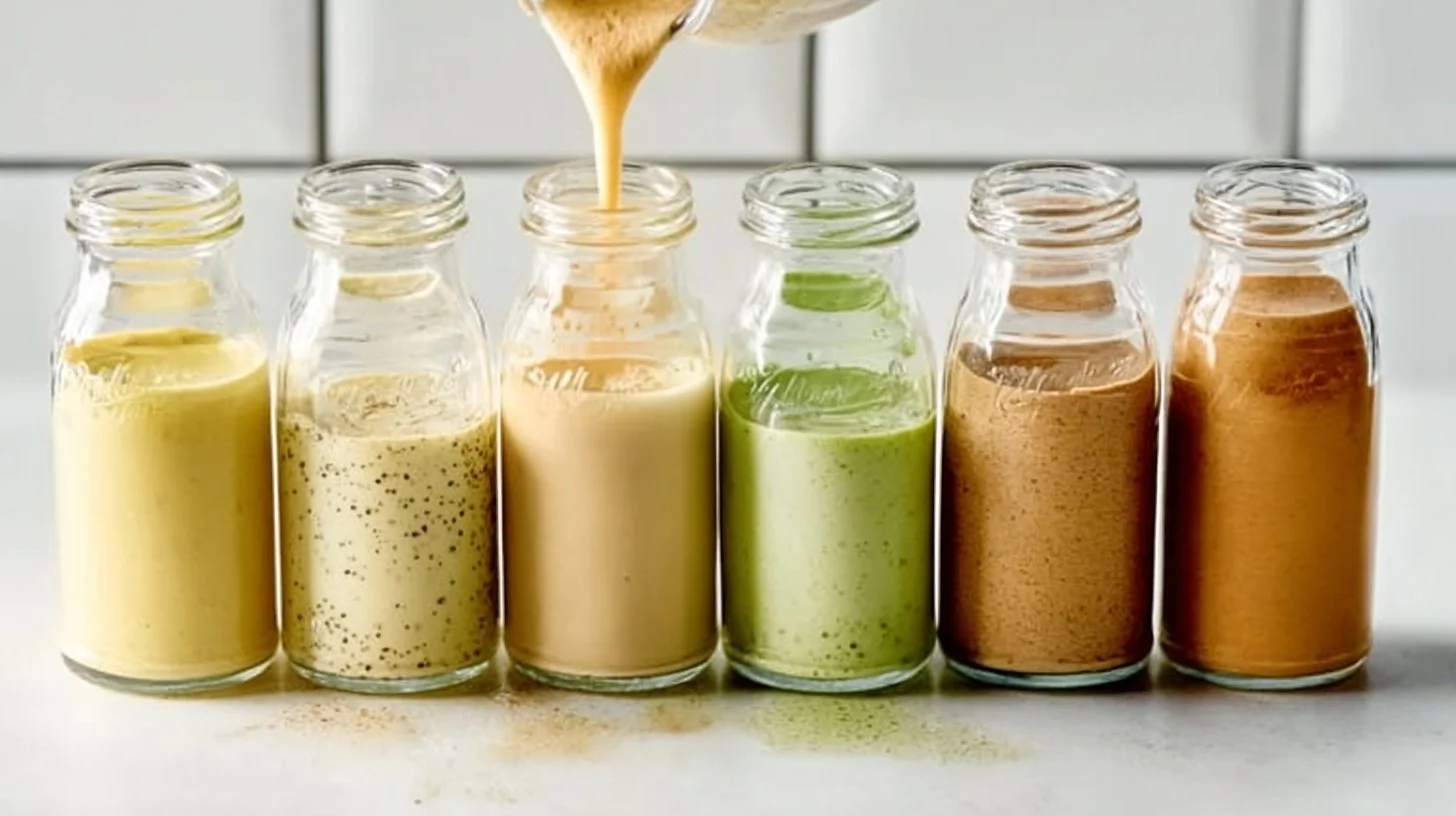
I never planned to become “the salad dressing person” at family gatherings, but once I learned a few simple ratios and tricks, homemade dressings turned ordinary greens into something my whole family fought over. These four dressings — a classic balsamic vinaigrette, a bright honey‑mustard, a tangy peanut dressing, and a fresh cilantro‑lime — are fast, flexible, and use pantry staples you probably already have.
Why you’ll love these dressings
These recipes are quick, economical, and far more flavorful than store-bought bottles. They come together in minutes, require no special equipment, and can double as marinades or dipping sauces. Make a batch on Sunday and you’ll have salad-ready options all week.
“Amazingly simple and bright — the cilantro‑lime is my go‑to for weekday lunches.” — home cook review
Reasons to try them
- Fast: most take under 5 minutes to assemble.
- Versatile: dress salads, slather on grain bowls, or use as marinades.
- Pantry-friendly: uses common items like olive oil, vinegar, honey, mustard, peanut butter, cilantro, and lime.
- Kid‑approved options: honey‑mustard and peanut dressings often win over picky eaters.
How this recipe comes together
First, you’ll pick a base (oil + acid for vinaigrettes; peanut butter or blended herbs for creamy styles). Next, combine and emulsify — whisk, shake, or blend — to create a smooth dressing. Finally, taste and adjust: add more acid for brightness, more oil for mellowness, or a pinch of salt to sharpen flavors. For herb dressings, blitzing creates the silkiest texture; for vinaigrettes, vigorous whisking or a mustard addition stabilizes the emulsion.
Step-by-step overview
- Gather ingredients and measure them out.
- For vinaigrettes: combine acid and flavorings, slowly whisk in oil to emulsify.
- For creamy/peanut dressings: blend ingredients to a smooth consistency; thin with water or lime juice as needed.
- Taste and adjust seasoning.
- Store in clean jars; shake or whisk before each use.
What you’ll need
- Balsamic vinegar (sub: red wine vinegar or sherry vinegar)
- Olive oil (sub: avocado oil or light-bodied vegetable oil for a milder taste)
- Honey (sub: maple syrup for vegan option)
- Mustard (Dijon or whole-grain)
- Peanut butter (smooth or crunchy; for peanut allergy substitute tahini or almond butter)
- Fresh cilantro (sub: parsley or basil for a different herb profile)
- Lime juice (fresh is best; bottled works in a pinch)
- Salt (kosher or sea)
- Black pepper (freshly ground)
Tiny substitution notes: use apple cider vinegar in place of balsamic for a brighter vinaigrette. If you want a creamier honey‑mustard, add a spoonful of Greek yogurt (keep it refrigerated and use within 3–4 days).
Directions
Follow these clear, short steps for each dressing.
Balsamic vinaigrette
- In a bowl or jar combine 1 part balsamic vinegar with 3 parts olive oil (for example, 1 tbsp vinegar + 3 tbsp oil).
- Add a pinch of salt and a few grinds of black pepper. Optionally add 1 tsp Dijon mustard or 1 tsp honey to help the emulsion.
- Whisk vigorously or close the jar and shake until emulsified. Taste and adjust salt, pepper, or acidity.
Honey‑mustard dressing
- In a small bowl mix 1 tbsp honey with 1 tbsp mustard.
- Slowly whisk in 3 tbsp olive oil until smooth. If it’s too thick, thin with 1 tsp water or lemon juice at a time.
- Season with salt and pepper to taste.
Peanut dressing
- Combine 2 tbsp peanut butter with 1–2 tbsp lime juice (or rice vinegar) in a bowl.
- Add 1–3 tbsp water to thin to desired consistency while whisking or blending.
- Season with a pinch of salt and black pepper. Optionally add a drizzle of honey or a teaspoon of soy sauce for depth.
Cilantro‑lime dressing
- In a blender or food processor, combine 1 cup packed cilantro leaves, 2–3 tbsp lime juice, 1/4 cup olive oil, and a pinch of salt.
- Blend until smooth, adding a tablespoon of water if needed to loosen.
- Taste and add more lime or salt as desired.
Storage note in steps: transfer dressings to clean glass jars with tight lids and refrigerate immediately.
Best ways to enjoy them
- Balsamic vinaigrette: drizzle over mixed greens, roasted vegetables, or grilled peaches.
- Honey‑mustard: toss with chopped chicken salad, use as a sandwich spread, or serve with roasted sweet potatoes.
- Peanut dressing: excellent on cabbage slaw, noodle salads, or as a dip for fresh spring rolls.
- Cilantro‑lime: pairs beautifully with taco bowls, grilled fish, or avocado salads.
Serving ideas
- Use small ramekins for individual salad dressings at a dinner party.
- Toss warm roasted vegetables with vinaigrette for an instant side dish.
- Marinate chicken or tofu in the peanut or cilantro‑lime dressings for 30–60 minutes before cooking.
How to store
- Refrigerate all dressings immediately in airtight glass jars. Keep fridge temperature at or below 40°F (4°C).
- Shelf life approximate: homemade oil‑and‑vinegar vinaigrettes — up to 2 weeks; honey‑mustard — about 1–2 weeks; peanut dressing — about 1 week; herb‑heavy cilantro‑lime — 3–5 days because fresh herbs shorten shelf life.
- Do not leave dressings at room temperature for more than 2 hours. Discard if you detect off smells, mold, or unusual texture changes.
- Freezing: generally not recommended for oil‑based dressings (they can separate and become cloudy). Creamy, dairy‑based dressings also separate when frozen. If you must freeze, do a small test batch and expect texture changes.
Safe handling tip: always use clean utensils to scoop dressings and avoid double‑dipping to keep them fresher longer.
Helpful cooking tips
- Master the 1:3 rule for vinaigrettes (acid:oil). Adjust to taste — some prefer 1:2 for a tangier result.
- Emulsify better by adding mustard or honey; they act as natural stabilizers.
- For the smoothest texture, use a blender for peanut and cilantro dressings. A stick blender works great directly in a jar.
- Taste in layers: after combining, rest 5 minutes then taste again — flavors meld and you’ll know whether to add acid, salt, or sweetener.
- If dressing separates, whisk or shake vigorously to re-emulsify. For stubborn separation, add a small spoonful of warm water and whisk.
- To make dressings lighter, reduce oil and add a tablespoon of plain yogurt or extra citrus. Refrigerate and use within 3–4 days.
Pro chef secret: make a “reverse emulsion” by slowly adding a tablespoon of vinegar into whipped oil — it creates an ultra‑stable, creamy vinaigrette.
Variations
- Vegan honey‑mustard: swap honey for maple syrup.
- Spicy peanut: add 1 tsp Sriracha or a pinch of chili flakes.
- Green vinegar swap: use apple cider or white wine vinegar instead of balsamic for a lighter vinaigrette.
- Nut‑free creamy: replace peanut butter with tahini or sunflower seed butter.
- Citrus herb: substitute lemon for lime and use parsley or basil in place of cilantro.
FAQs
Q: How long do homemade dressings last in the fridge?
A: Generally, oil‑and‑vinegar vinaigrettes keep up to 2 weeks. Dressings with lots of fresh herbs last 3–5 days. Creamy or nut‑based dressings last about 1 week. Always refrigerate and discard if anything smells off.
Q: Can I use other oils besides olive oil?
A: Yes. Avocado oil, grapeseed, or light vegetable oils work well and give a milder flavor. Extra‑virgin olive oil has a stronger, fruity taste that pairs nicely with balsamic.
Q: Are these dressings safe to use as marinades?
A: Yes. Vinaigrettes and peanut or cilantro dressings make good marinades for chicken, tofu, or vegetables. For food safety, marinate in the fridge and never reuse marinade that’s been in contact with raw meat unless you boil it first.
Q: How can I thicken a dressing?
A: Add Greek yogurt, tahini, or a bit of pureed avocado for body. For vinaigrettes, use a teaspoon of Dijon mustard or an emulsifier (egg yolk in classic preparations) — but follow safe‑egg guidelines if using raw egg.
Q: How do I fix a dressing that’s too tart or too oily?
A: Too tart? Add a little extra oil or a touch of sweetener (honey or maple). Too oily? Add more acid (vinegar or lime juice) and a pinch of salt to rebalance.
If you want, I can convert these proportions into specific cup/tablespoon measurements for one‑cup batches or create printable jar labels with suggested use-by dates. Which would be most helpful?
Print
Homemade Salad Dressings
- Total Time: 5 minutes
- Yield: 4 servings
- Diet: Vegan
Description
Quick and flavorful homemade salad dressings that elevate your greens and are perfect for any family gathering.
Ingredients
- Balsamic vinegar (sub: red wine vinegar or sherry vinegar)
- Olive oil (sub: avocado oil or light-bodied vegetable oil)
- Honey (sub: maple syrup for vegan option)
- Dijon mustard (or whole grain)
- Peanut butter (smooth or crunchy; substitute tahini for allergies)
- Fresh cilantro (sub: parsley or basil)
- Lime juice (fresh is best)
- Salt (kosher or sea)
- Black pepper (freshly ground)
Instructions
- Gather ingredients and measure them out.
- Combine acid and flavorings, slowly whisk in oil to emulsify for vinaigrettes.
- Blend ingredients to a smooth consistency for creamy dressings.
- Taste and adjust seasoning.
- Store in clean jars; shake or whisk before each use.
- Balsamic vinaigrette: 1 part balsamic vinegar with 3 parts olive oil, whisk vigorously.
- Honey–mustard: mix honey with mustard, whisk in olive oil.
- Peanut dressing: combine peanut butter with lime juice, whisk in water.
- Cilantro dressing: blend cilantro leaves, lime juice, olive oil, and salt.
Notes
Dressings can double as marinades and are versatile for various dishes.
- Prep Time: 5 minutes
- Cook Time: 0 minutes
- Category: Condiment
- Method: Mixing
- Cuisine: Various