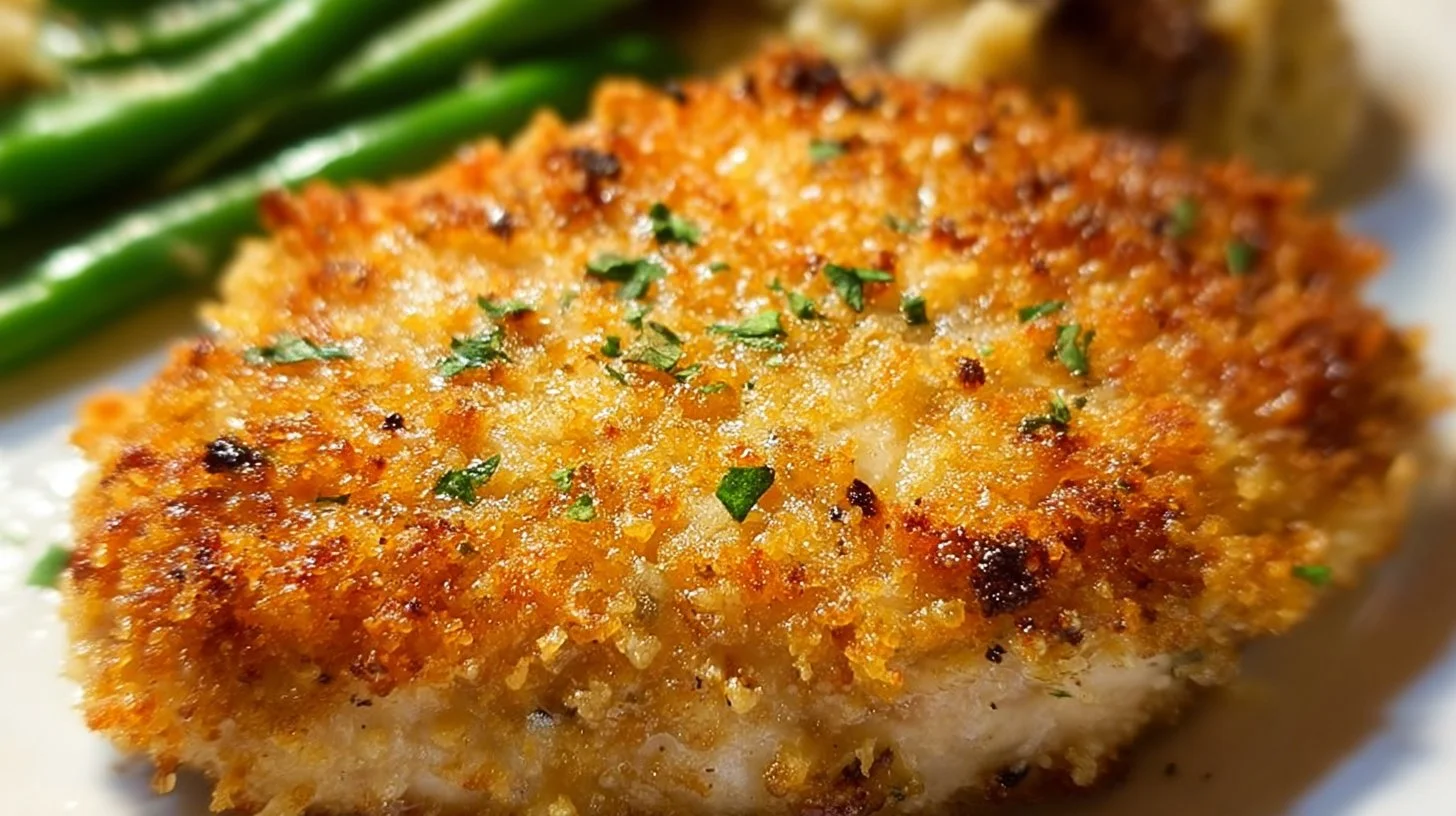
This Parmesan-crusted chicken gives you golden, crunchy crust and a juicy interior with very little fuss. A quick pan-sear locks in flavor, then a short bake finishes the cook and keeps the crust crisp. It’s a weeknight winner that also dresses up nicely for guests.
Why you’ll love this dish
This recipe balances speed and texture: a breadcrumb-Parmesan crust that browns beautifully in a skillet, and a brief oven finish that ensures safe, even cooking without drying the meat. It’s versatile — serve it with pasta, a salad, or roasted vegetables — and it’s easy to scale up for a crowd.
“Crunchy outside, tender inside — my whole family asked for seconds. Ready in under 40 minutes.” — home-cook review
Reasons to try it:
- Fast enough for weeknights but pretty enough for entertaining.
- Uses pantry staples: breadcrumbs and Parmesan add big flavor.
- Kid-friendly and adaptable (gluten-free, low-carb, spicy).
How to make Parmesan Crusted Chicken
Step-by-step overview
- Pound or butterfly breasts to an even thickness so they cook uniformly.
- Set up a dredging station: seasoned breadcrumb-Parmesan mixture and beaten eggs.
- Dip each breast in egg, press into crumbs to form a good coating.
- Sear briefly in hot oil until the crust sets and turns golden.
- Transfer to the oven to finish cooking through (internal temp 165°F / 74°C).
- Rest 5 minutes, slice, and serve.
This method—sear then bake—gives a reliably crisp crust without overcooking the chicken.
Ingredients
What you’ll need (serves 4)
- 4 boneless, skinless chicken breasts (about 1 to 1¼ lb total). Optional: use thighs if preferred (see Variations).
- 1 cup breadcrumbs (panko yields extra crunch; plain or seasoned breadcrumbs also work)
- ½ cup grated Parmesan cheese (freshly grated for best flavor and melting)
- 1 teaspoon garlic powder
- 1 teaspoon onion powder
- 1 teaspoon Italian seasoning (or ½ tsp dried oregano + ½ tsp dried basil)
- Salt and freshly ground black pepper, to taste (about ½–1 tsp salt total)
- 2 large eggs, beaten
- 2–3 tablespoons cooking oil with a high smoke point (vegetable, canola, or light olive oil)
Substitutions/notes inline:
- For gluten-free: use certified gluten-free breadcrumbs or crushed cornflakes; almond flour or crushed pork rinds work for low-carb.
- For dairy-free: swap Parmesan for nutritional yeast or a dairy-free hard cheese; expect slightly different flavor.
- If breasts are thick, halve horizontally or pound to ~½ inch thickness for even cooking.
Directions
Step-by-step instructions
- Preheat the oven to 400°F (200°C). Place a wire rack on a baking sheet if you have one (helps crisp all sides).
- Prepare the chicken: pat breasts dry. If uneven, butterfly or gently pound them to an even ½-inch thickness. Season both sides lightly with salt and pepper.
- Make the breadcrumb mix: in a shallow bowl, combine breadcrumbs, grated Parmesan, garlic powder, onion powder, Italian seasoning, and a pinch of salt and pepper. Stir to distribute.
- Beat eggs in a separate shallow bowl until smooth.
- Coat the chicken: dip a breast into the beaten eggs, letting excess drip off. Press it into the breadcrumb mixture, turning and pressing so the crumbs adhere and form a uniform crust. Shake off loose crumbs. Repeat for all breasts.
- Heat oil in a large skillet over medium heat. The oil should shimmer but not smoke; about 2–3 minutes.
- Sear the chicken: add chicken to the skillet (don’t overcrowd — do in batches if needed). Cook 3–4 minutes per side, until the crust is golden brown and holds together. Use tongs and avoid flipping more than once.
- Transfer to the prepared baking sheet or a shallow baking dish. Bake in the preheated oven 12–18 minutes, depending on thickness, until internal temperature reaches 165°F (74°C) at the thickest part. (If using a wire rack, the air circulates and crust stays crisp.)
- Rest the chicken 5 minutes before slicing. Resting lets juices redistribute and keeps the meat juicy. Serve hot.
Timing notes: total active time ~20 minutes. Oven finish varies with thickness; plan 30–40 minutes total from start to table.
How to serve Parmesan Crusted Chicken
Best ways to enjoy it
- Classic: slice and serve over spaghetti tossed with olive oil, lemon, and parsley.
- Lighter: serve whole on a bed of mixed greens with cherry tomatoes and a lemon vinaigrette.
- Comfort: pair with mashed potatoes and roasted green beans.
- For brunch: top with a fried egg and serve with roasted potatoes.
Plating tips:
- Slice across the breast at a 45° angle for attractive presentation.
- Add a squeeze of lemon over the crust for bright contrast.
- Sprinkle extra grated Parmesan and chopped parsley for color.
How to store
Storage and reheating tips
- Refrigerator: Cool to room temperature (no more than 2 hours after cooking), then store in an airtight container for up to 3–4 days. Place paper towel between pieces if stacking to preserve crust.
- Freezer: Wrap individually in plastic wrap and place in a freezer bag or airtight container. Freeze up to 2–3 months for best quality. Thaw in the refrigerator overnight before reheating. Do not refreeze after thawing.
- Reheating: For best crispness, reheat in a 350°F (175°C) oven on a wire rack for 8–12 minutes until the center reaches 165°F (74°C). An air fryer at 350°F for 6–8 minutes also restores crunch. Microwaving will heat but soften the crust.
Food safety: always ensure chicken reaches 165°F (74°C) before serving. Refrigerate leftovers within 2 hours of cooking.
Tips to make
Helpful cooking tips
- Even thickness = even cook: pound or slice breasts for consistent results.
- Press crumbs firmly: press the breadcrumb mixture into the chicken to form a compact crust that won’t fall off during flipping.
- Don’t overcrowd the pan: give pieces room to brown. Crowding steams the crust.
- Use a wire rack for oven finish: keeps bottom crisp.
- Use fresh Parmesan: pre-grated cheese contains anti-caking agents and won’t melt or brown as well.
- Test one piece: if your skillet cooks hot, reduce to medium-low to prevent burning the crust before the center is done.
- Flavor boost: add 1–2 tablespoons of melted butter to the breadcrumb mix for richer browning.
Pro tip: a thin smear of Dijon or mayonnaise under the breadcrumb layer helps adhesion and adds flavor while keeping the crust crisp.
Variations
Creative twists
- Lemon-Parmesan: add 1 tsp lemon zest to the breadcrumb mix for brightness.
- Herby crust: fold in 2 tbsp finely chopped fresh parsley, basil, or thyme.
- Spicy: add ½–1 tsp smoked paprika or cayenne to breadcrumbs for heat.
- Panko-only: use all panko for an extra light, crunchy crust.
- Almond-crust (low-carb): replace breadcrumbs with 1 cup finely ground almonds + ¼ cup grated Parmesan.
- Chicken thighs: swap breasts for boneless skinless thighs; reduce bake time slightly and watch for doneness.
- Stuffed variation: butterfly breasts, add a slice of prosciutto and a thin piece of mozzarella, then bread and cook (secure with toothpicks).
FAQs
Common questions
Q: Can I make this ahead for a party?
A: Yes. Cook and cool the chicken, refrigerate up to 24 hours. Reheat in a 350°F oven on a wire rack for 10–12 minutes. For best texture, consider cooking through sear only the morning of the event and finish in the oven just before serving.
Q: What is the best way to keep the crust from falling off?
A: Dry the chicken well, press the crumbs firmly onto the egg-coated surface, and don’t flip too often during searing. Using a thin layer of mayo or Dijon under the crumbs can improve adhesion.
Q: Can I use frozen chicken?
A: Thaw completely in the refrigerator before breading. Partially frozen chicken won’t bread properly and won’t cook evenly.
Q: How do I know it’s cooked through?
A: Use an instant-read thermometer inserted into the thickest part; it should read 165°F (74°C). Visual indicators (clear juices, no pink near the bone) are useful but less reliable than a thermometer.
Q: Is there a gluten-free version?
A: Yes — use certified gluten-free breadcrumbs or panko. For a grain-free option, try almond flour or crushed pork rinds.
Q: How long will leftovers stay safe to eat?
A: Stored in the fridge in an airtight container, leftovers are safe for 3–4 days. Reheat until 165°F before serving.
If you want, I can adapt this to a gluten-free, low-carb, or kid-friendly version and give exact timing for chicken thigh substitutes. Which variation would you like?